|
The Milton Margal School for the
Blind was founded in May 1956 with Government support.
For the first seven years of its
existence, the school had a temporary home in a rented house in
College Road in Congo Cross, Freetown.
The one foundation teacher was
Miss Wilhemina Johnson, who had a UK certificate in Special Education,
and was herself only partially sighted. The school had an initial
roll of 3 pupils. Mr Samuel Campbell assumed office as teacher/headmaster
of the school in January 1959.
The steady growth attained by
the school in the enrolment, from three pupils in 1956 to fourteen
(ten boys and four girls) in 1959, was a most substantial indicator
of the need for the school in Sierra Leone. With fourteen fully
boarding pupils, the restricted temporary school building was
at full capacity. During Independence in 1961, an appeal was launched
for funds and materials, and with the enthusiastic approval of
the then Prime Minister, Sir Milton Margai construction began
on a permanent building for the school. Negotiations with the
Government for land led to the allocation of ten acres of state
land, which now provides the permanent site for the school on
Wilkinson Road, Freetown.
On the 26th April 1962, in commemoration
of the first Independence Anniversary of Sierra Leone, the Right
Honourable Sir Milton Margal laid the foundation stone of the
present permanent site on Wilkinson Road and the school was renamed
as the Sir Milton Margal School for the Blind.
The original building was a single
storey building with classrooms, offices, dormitories, dining
room, kitchen and storage rooms, all leading directly off walkways
which form the four sides of a square.
The library and additional classrooms
were added in 1974 and 1979. In 1982, the Christoffel House building
was constructed as a gift from the Christoffel Blinden Mission
in Germany. This two storey co-educational building contains large
dormitories and a staff annexe on each floor.
There are presently 83 pupils
- 42 primary, 27 secondary, 5 vocational, 8 college, and 1 university
student. There are 7 teachers, 10 ancillary staff, the Matron,
2 Braillists, 1 Secretary, 1 Assistant Administrator, the Deputy
Headmaster and the Headmaster.
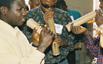
The school follows a normal Primary
curriculum but with extra emphasis on Braille reading and writing
and on Typing. We have various extra curricula activities in particular,
singing - the choir is renowned throughout Sierra Leone and even
overseas.
The school has seen through the
recent turmoil of Sierra Leone's savage civil war. It was evacuated
during the coup in 1998, and was affected by shelling in 1999
owing to it's close proximity to the neighbouring Cockerill Barracks,
home at that time to the Nigerian ECOMOG force. A number of pupils
were blinded by rebels during the conflict, and many others were
affected through loss of family members.
The school has the most basic
of facilities, but strives hard and does achieve high academic
standards. Pupils battle daily with the difficulties they face
living in a culture that does not always value the disabled, and
yet many of those leaving go on into higher education. The atmosphere
at the school is a very happy one as the staff endeavour to give
the blind pupils a normal school and home environment. They are
provided with a good education and the welfare and mobility skills
that will equip them for life.
|